2 methods
passive & active
How to make an asset's location update on its own — with fixed passive UHF readers at choke points, and battery-powered V-Tag active mesh tags for hands-free, zone-level visibility. AssetWorx! runs both in one system.
Active tracking with RFID means an asset's location updates on its own — automatically, with no one pulling a scanner trigger. There are two ways to do it. Passive UHF RFID puts a battery-free tag on each asset and reads it whenever it passes a fixed reader at a choke point — a doorway, a dock, a portal. Active RFID puts a small battery-powered tag on the asset itself; InfinID's V-Tag tags link into their own Zigbee self-healing mesh and report which zone each asset is in, hands-free, with no fixed readers to wire. Most real deployments use both: passive UHF for high-volume choke-point reads, and active V-Tag mesh for continuous zone-level awareness across an open floor. AssetWorx! runs both technologies in one system, so you see every asset — passive and active — on a single map.
There are two primary means of active tracking with RFID. They solve different problems, and the strongest systems combine them.
Passive RFID tags are attached to the assets you need to track. They have no battery and can't transmit on their own — they only wake up when an RFID reader powers them. That's the key: passive tracking is only as good as where you place your readers.
There are two kinds of RFID reader, and only one automates tracking. Mobile (handheld) readers are driven by a person — you pull a trigger to sweep the tags nearby — so they're built for inventory counts and searching, not automatic updates. Fixed readers mount on a wall, ceiling, or portal frame and read every tag that passes within range, with no human in the loop. Active tracking with passive RFID means placing fixed readers at strategic points so the system sees assets move on its own.
Setting up reliable location tracking with passive RFID takes planning — the right hardware and reader placement decide whether the project succeeds. Start by identifying exactly where you need visibility:
Tracking assets by room is one of the easiest ways to get active tracking from passive RFID. Place a fixed reader at each room entrance for room-level accuracy. Because doorways are narrow, an asset is forced through a tight, predictable read zone — so dial in the antenna coverage for maximum read reliability right at the threshold.
Tracking in a large, open environment is harder: assets can take many paths, so there's no single doorway to cover. Two proven layouts help:
Active RFID tags have their own battery, so they can communicate without a reader powering them. InfinID's V-Tag is an active RFID tag with a patented Zigbee mesh network architecture — the tags talk to each other, forming a dynamic wireless network that routes each report to a gateway. No fixed-reader grid to wire.
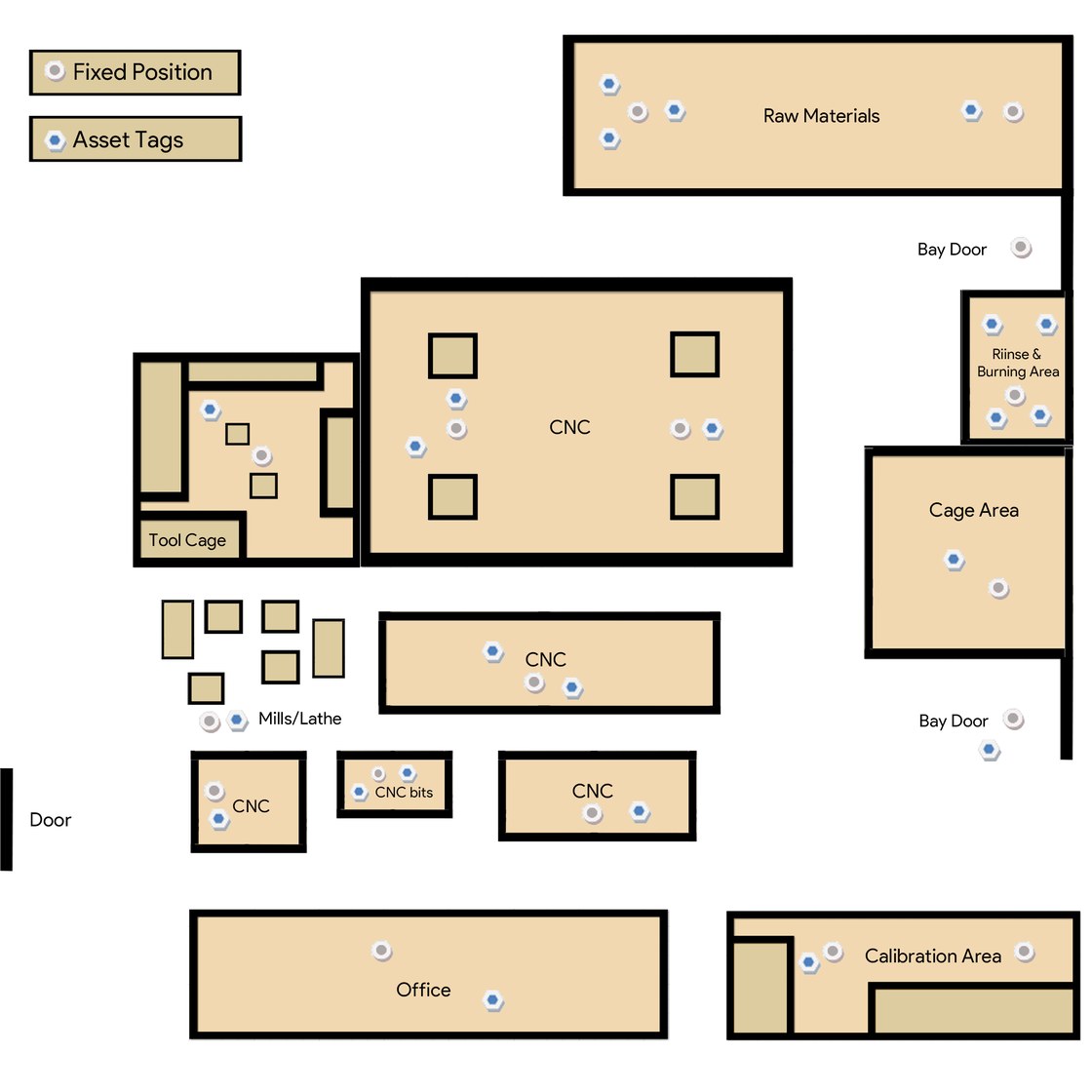
V-Tag is an active Zigbee self-healing mesh built for reliable zone-level location — which zone an asset is in, kept current as it moves. It is not RTLS, not sub-second, and not a beacon-positioning system. Positions settle across the mesh in roughly 3–4 minutes — the honest trade for battery life measured in years and almost no fixed infrastructure. And because every tag relays for the others, more tags make the mesh stronger, not slower. The patented routing (US 8,094,022 B2) lets each tag decide whether to rebroadcast, so reports find their own way to the gateway.
Outdoor tracking covers far larger areas than an indoor floor, so it needs a different tool. For laydown yards, lots, shipping yards, and oil & gas facilities, the V-Tag family includes a GPS / LoRaWAN option: attach the tag to the asset, and when it moves it reports its position across wide, open areas back through a gateway to your software. It's a natural fit anywhere equipment gets lost across a big site and crews waste hours hunting for it.
You rarely have to choose. Passive UHF is unbeatable for high-volume reads at choke points; active V-Tag mesh gives continuous, hands-free zone awareness where there's no doorway to cover. AssetWorx! runs both technologies together, so every asset — passive and active — shows up in a single, current view.
No. Handheld (mobile) readers are operated by a person pulling a trigger, so they're for inventory and search. Active tracking — where locations update on their own — needs fixed readers (for passive) or active V-Tag mesh tags.
Not indoors. V-Tag gives dependable zone-level location that settles across the mesh in about 3–4 minutes — not a live GPS dot. That trade buys years of battery life and almost no infrastructure. For wide outdoor sites, the V-Tag GPS / LoRaWAN option reports position across large areas.
Use passive UHF where assets funnel past a fixed point at volume — doors, docks, portals. Use active V-Tag mesh where you need continuous, hands-free awareness across open space with no doorway to cover. Many sites use both, unified on AssetWorx!.
Assets, tooling, inventory, work-in-process — we'll help you choose the right mix of passive UHF and active V-Tag mesh, and quote it on AssetWorx!.
Request a quote