If your medical equipment management plan still cites EC.02.04.01, it is citing a standard number that stopped existing on January 1, 2026. The Joint Commission physical environment chapter replaced the Environment of Care and Life Safety chapters that day, every standard and element of performance was renumbered, and the detailed EPs covering equipment inspection, testing, and maintenance were deleted outright.
Nothing about what you actually have to do changed. The Joint Commission has been clear and consistent about that. What changed is every number in your binders, your policy headers, your CMMS report titles, and the tab labels in the document review binder you hand a surveyor. And what changed underneath that, in a way that gets less attention, is where the detail now lives and what a surveyor is going to ask you to produce on the floor.
This is written for the biomed, clinical engineering, and facilities people who have to reconcile eight months of stale documentation against a manual that no longer matches it.
What actually changed on January 1, 2026
The Joint Commission’s Accreditation 360 rewrite collapsed two chapters into one and pulled some content into a third.
All Environment of Care standards and EPs were renumbered and moved out of EC. Most landed in the new Physical Environment (PE) chapter. Some moved to a new National Performance Goals (NPG) chapter, which the Joint Commission created for its own requirements aimed at preventing patient harm. All Life Safety standards and EPs were renumbered and moved into PE as well.
From the Joint Commission’s own webinar transcript on the change: “These requirements will be effective January 1, 2026,” and “As of January 2026, Environment of Care-related requirements will be located in two chapters.”
The PE chapter has eight standards:
| Standard | Concept |
|---|---|
| PE.01.01.01 | Safe, adequate environment |
| PE.02.01.01 | Hazardous materials and waste |
| PE.03.01.01 | Comply with the Life Safety Code |
| PE.03.02.01 | Interim Life Safety Measures |
| PE.04.01.01 | Building safety and facility management |
| PE.04.01.03 | Utility systems |
| PE.04.01.05 | Water management program |
| PE.05.01.01 | Imaging safety |
Four physical environment topics went to NPG instead: workplace violence worksite analysis, managing security risks, managing utility systems, and managing imaging safety risks. Utility systems and imaging safety appear on both lists because the concepts were split across the two chapters, which is exactly the kind of thing that will burn you if you are updating documents by find-and-replace.
Read that table again and notice what is not on it. There is no medical equipment standard.
Where medical equipment management actually went
Here is the honest answer, and it is more interesting than a simple renumbering.
The Joint Commission’s PE webinar deck lists, under Notable Changes in the New PE Requirements, a Deleted bullet reading: “Detailed EC standards related to equipment inspection, testing, and maintenance.”
That is not a relocation. Those detailed EPs are gone as EPs. The webinar transcript explains the mechanism generally when describing the Disposition Report: “In some cases, a requirement is deleted, and the concept is moved to the Survey Process Guide or SPG. The phrase ‘moved to guidance within SPG’ means that the details behind a requirement and the information on how this requirement will be evaluated will now be found in the SPG document.”
So where does a surveyor cite you now if your medical equipment inventory is wrong?
PE.04.01.01, EP 2: “The hospital maintains essential equipment in safe operating condition.”
That mapping comes from the 2026 Physical Environment Update presented by David C Thompson II, Associate Field Director for Life Safety Code Surveyors at the Joint Commission. His building tour guidance table has a Medical Equipment row, and the questions listed in it are the ones a surveyor will actually ask:
- Is the medical equipment in the medical equipment inventory?
- Has the organization identified the equipment as high risk or non-high risk?
- Can the organization tell you what type of maintenance they are doing, OEM or AEM?
- Is the equipment up to date on its PMs?
The standard cited alongside those questions is PE.04.01.01 EP 2.
That citation is confirmed by the Joint Commission’s own Prepublication Requirements report issued January 26, 2026, which states PE.04.01.01 as “The hospital addresses building safety and facility management” and its EP 2 as “The hospital maintains essential equipment in safe operating condition.”
The same report revises EP 2 effective March 1, 2026, and the revision matters more to inventory owners than the renumbering did. It adds:
Note 2: For all other equipment: Inspection, testing, and maintenance activities are documented in accordance with manufacturer’s recommendations or established alternative equipment maintenance (AEM) activities and frequencies defined in the AEM program.
So the AEM and OEM question the surveyor asks on the building tour is not just guidance sitting in the Survey Process Guide any more. As of March 1, 2026 the documentation requirement is written into the element of performance. You have to be able to produce, per device, which maintenance regime it is on and the records that prove the defined frequency was met. That is an inventory record problem before it is a maintenance problem.
Read that list carefully, because it is the whole point of this article. Four questions, and the first three are inventory questions. Only the last one is a maintenance question. A surveyor can fail you on three of four before anyone opens a work order.
One more wrinkle worth knowing: the Survey Process Guide’s Physical Environment Document List and Review Tool excludes medical equipment. Medical equipment is handled separately in the survey rather than inside the PE document review packet. If your survey prep plan assumed the PE document list would cue you for medical equipment records, it will not.
What the old standard required, and why that still matters
EC.02.04.01 was titled “The hospital manages medical equipment risks.” EC.02.04.03 was “The hospital inspects, tests, and maintains medical equipment.”
Between them they required a written inventory of medical equipment, identification of high-risk equipment on that inventory (high-risk explicitly including life-support equipment), written maintenance and inspection activities with their frequencies, and a declared maintenance strategy that is either the manufacturer’s recommendations or a documented alternative equipment maintenance program. Hospitals using Joint Commission accreditation for deemed status had the stricter version: a written inventory of all medical equipment, not a risk-selected subset.
Those obligations did not evaporate when the EPs did. CMS Condition of Participation 482.41 still requires the hospital to maintain facilities and equipment to ensure safety, and the new Survey Process Guide is organized by CoP, with 482.41 as the physical environment module. The Joint Commission simplified its own crosswalks so its standards map more directly onto CMS language. The floor under you is CMS, and CMS did not move.
What actually changed for you is the burden of proof. When the requirement was spelled out across a dozen numbered EPs, compliance was a checklist exercise. Now the EP text is one sentence about essential equipment in safe operating condition, and the evaluation detail sits in a guidance document. The surveyor has more room to probe, and the thing they probe first is whether your inventory is real.
The five findings the Joint Commission is actually writing
The same Joint Commission source publishes the most frequent EC findings for the hospital program between May 2024 and May 2025:
| Finding | Opportunities documented |
|---|---|
| Interior space safety and suitability | 865 |
| Utility system control labelling | 785 |
| Utility system testing | 684 |
| Cleanliness of the environment | 615 |
| Handling and storage of hazardous chemicals | 611 |
And their new homes, per the Joint Commission’s own crosswalk examples:
- Interior space safe and suitable: EC.02.06.01 EP 1 is now PE.01.01.01 EP 1 and EP 2
- Utility system control labels: EC.02.05.01 EP 9 is now PE.04.01.01 EP 1 (Health Care Facilities Code)
- Non-high-risk utility system test: EC.02.05.05 EP 6 is now PE.04.01.01 EP 2 (Maintenance of Essential Equipment)
- Clean environment, no odors: EC.02.06.01 EP 20 is now PE.01.01.01 EP 3
- Hazardous chemical handling and storage: EC.02.02.01 EP 5 is now PE.02.01.01 EP 4
Notice that PE.04.01.01 EP 2 catches both non-high-risk utility system testing and medical equipment. That single EP is now doing a great deal of work, and it is where inventory accuracy and maintenance completion converge.
What an equipment inventory has to be able to produce now
Strip away the numbering and the surveyable question is: can you stand in a hallway, point at a device, and reconcile it to a record in under a minute?
That means your inventory has to answer, per device:
- Is it on the inventory at all. The device in front of the surveyor, not a device like it.
- Where is it right now, and is that plausible. A record that says a pump lives in a storeroom it left in March is a record nobody trusts.
- Is it flagged high-risk or non-high-risk. With life-support equipment identified as high-risk.
- Which maintenance strategy governs it. OEM recommendations or a documented AEM program, and which devices sit in the AEM program.
- Is it current on its scheduled maintenance, with the documentation to show it.
Items 3, 4, and 5 are CMMS problems. Your maintenance system probably handles them, and if it does not, no tracking technology is going to fix that.
Items 1 and 2 are inventory problems, and they are the ones that quietly rot. Devices get borrowed between units, sent out for repair and returned to the wrong department, retired without being retired in the system, or bought on a departmental card and never entered at all. Every hospital has a number for how far its equipment records have drifted, and most of them do not like the number.
Where RFID genuinely helps here, and where it does not
Two honest framings, because this is where vendor content usually stops being useful.
RFID does not make you compliant. There is no standard, old or new, that asks whether you have RFID. A surveyor asks whether the device is on the inventory, classified, and maintained. RFID is a way to keep the answer to the first two accurate at a cost in labor you can actually sustain. That is all it is, and that is worth quite a lot.
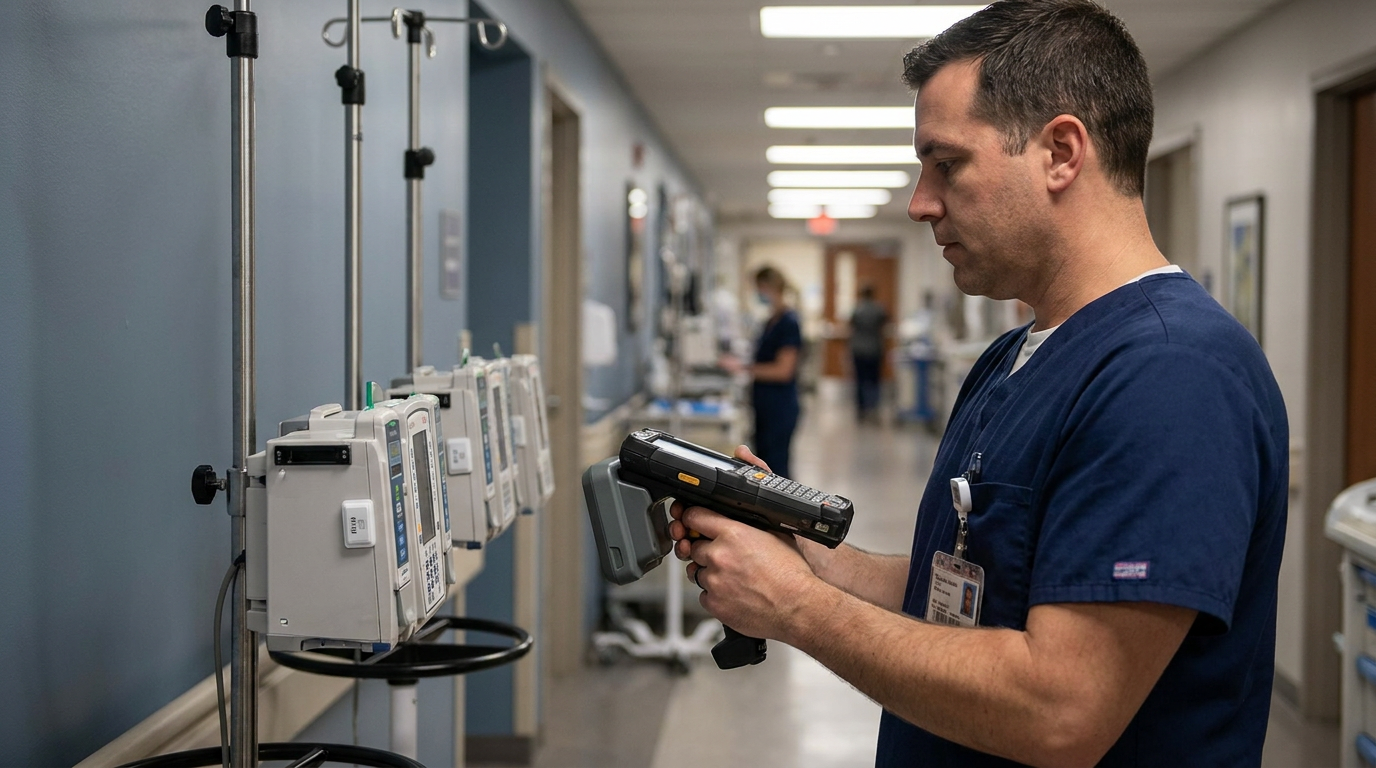
The realistic win is the audit cycle, not live tracking. Passive UHF RFID, the EPC Gen 2 standard operating at 902 to 928 MHz in the US, uses tags with no battery. They harvest power from the reader’s signal, cost from roughly a dime to a few dollars depending on form factor and volume, never need a battery change, and read at roughly 5 to 20 feet with standard antennas. What that buys you is a fast physical count. A technician with a handheld reader, for example a Zebra RFD40 sled paired with a TC22R mobile computer, walks a unit and collects every tagged device in range without opening a drawer, touching a device in use, or reading a faded asset sticker on the underside of a pump.
An inventory reconciliation that used to take a two-person team a week can become something a single tech does floor by floor on a rolling schedule. That is the mechanism by which inventory accuracy actually improves: not because the technology is magic, but because the count gets cheap enough to do often instead of annually before survey.
Fixed readers at defined choke points, typically Zebra FX9600, Zebra FXR90, or Impinj Speedway R420 talking LLRP over Ethernet, add a second layer: you know when a tagged device crossed a doorway. That catches the borrowed-and-never-returned pattern without requiring anyone to scan anything.
Be precise about what location data you are buying. A passive UHF system tells you a device was read at a reader, or was in range of a handheld, at a moment in time. It does not continuously report where every device is. That distinction matters when you are writing the business case, and it matters more when a clinician asks what the system will do for them. Systems that do report ongoing zone-level presence are a different technology class with different economics, and they update on an interval rather than instantly. Sizing a project around precision you will not act on is the most reliable way to overspend on one of these.
We have run the periodic-inventory pattern in production. One public agency deployment tags every asset at receiving, reads tags with a short-range passive reader in the stockroom, and records the purchase order number, the tag, and the serial number together so the financial record and the physical record are created in the same motion. That is a plain workflow, not a moonshot, and it is the shape of thing that survives contact with a real hospital.
A practical cleanup order before your next survey
If you are looking at stale documentation and limited hours, sequence it this way.
Fix the citations, not the content. Your medical equipment management plan is almost certainly still correct in substance. Update the standard references, and where the old detailed EPs no longer exist, reference PE.04.01.01 EP 2 and point your own internal guidance at the Survey Process Guide rather than inventing a replacement EP number. Pull the Disposition Report from the Joint Commission’s prepublication page and let it drive the find-and-replace, device by device, rather than working from a vendor blog. This one is free and it is the one most likely to embarrass you.
Then measure inventory accuracy before you buy anything. Take one unit. Physically walk it. Count what is there against what the record says is there. The gap you find is your actual business case, expressed in a number your CFO will accept. If the gap is small, you have a documentation problem, not a tracking problem, and RFID will not help.
Then classify. High-risk versus non-high-risk, life-support identified, AEM membership explicit. This is a data hygiene task, it is cheap, and it answers two of the four questions a surveyor asks.
Then, if the gap justified it, tag. Start with the categories that move: infusion pumps, portable monitors, ventilators, specialty beds. Devices bolted to a wall do not have an inventory drift problem.
Prepare medical equipment records separately. Since the PE Document List and Review Tool excludes medical equipment, build that packet on its own rather than expecting the PE document review to prompt you for it.
FAQ
Is EC.02.04.01 still a valid standard number? No. As of January 1, 2026, the EC chapter no longer exists in the Joint Commission’s accreditation manual. EC standards were renumbered into the PE chapter or the NPG chapter, and the detailed EPs covering equipment inspection, testing, and maintenance were deleted as EPs.
Did the medical equipment requirements go away? No. The Joint Commission has been explicit that no concepts were introduced or removed, only reorganized, and that an organization meeting the old requirements will be meeting the new ones. The detail moved into the Survey Process Guide, and CMS Condition of Participation 482.41 is unchanged.
Which standard gets cited if my equipment inventory is inaccurate? Per the Joint Commission’s own 2026 Physical Environment Update building tour guidance, the Medical Equipment row cites PE.04.01.01 EP 2, “The hospital maintains essential equipment in safe operating condition.” Confirm against the Disposition Report for your specific EPs.
Do I need to rewrite my medical equipment management plan? Most likely you need to re-reference it rather than rewrite it. The substance should still hold. What will not hold is a plan whose section headers cite EPs that no longer exist.
Does RFID satisfy the Joint Commission? No technology satisfies a standard. Surveyors ask whether the device is on the inventory, correctly classified, and current on maintenance. RFID is a method for keeping inventory accuracy high at a labor cost you can sustain, which is a means to an end rather than the end.
Passive or active RFID for medical equipment inventory? For periodic physical counts and choke point visibility, passive UHF is the cost-appropriate answer: cheap tags, no batteries, handheld and fixed readers. Continuous zone-level presence is a different technology class with a much higher per-tag cost and a positional update that arrives on an interval. Decide which one your workflow will actually act on before you price either.
Sources
- Joint Commission, Accreditation 360 - Updated Accreditation Manual: Physical Environment Chapter, on demand webinar transcript and slides, September 2025. Transcript and accessible slides
- David C Thompson II, MPA, CHFM, CHSP, CHC, Associate Field Director, Life Safety Code Surveyors, Joint Commission, 2026 Joint Commission Physical Environment Update, TAHFM annual conference, © 2026 Joint Commission. PDF
- Justin Marcoux, Joint Commission’s New Physical Environment and National Performance Goals, NEHES conference, 2026. PDF
- Joint Commission, Prepublication Standards page, where the Disposition Report and Crosswalk Compare Reports are posted. Link
- Joint Commission, Accreditation 360 FAQs. Link