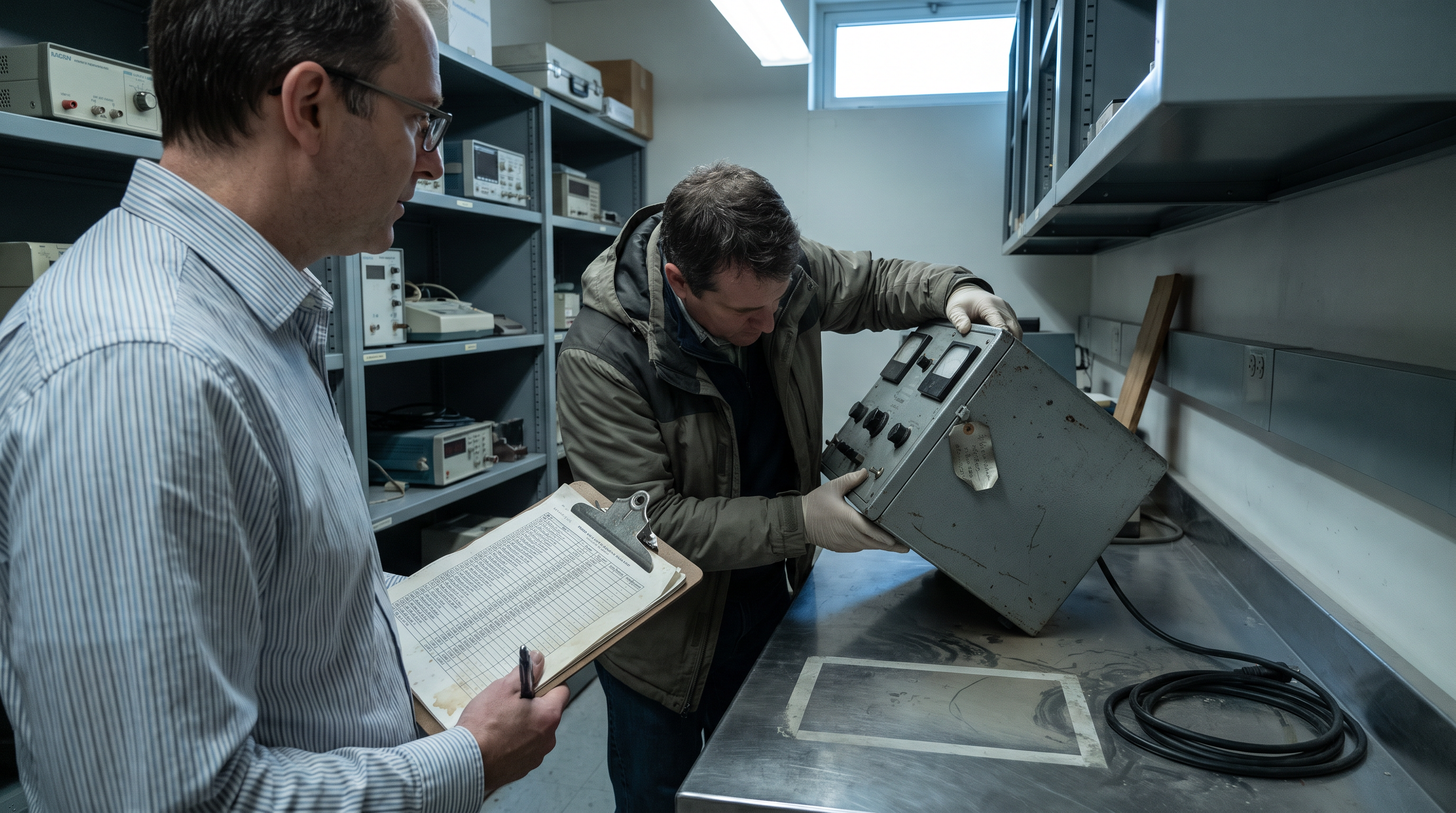
A federal grant equipment inventory sounds like a counting exercise, and that is why it goes badly. Two people walk a building with a printed list. They find things. They tick them off. Somebody signs the bottom of the page.
Then the auditor arrives and asks a different question, and the count turns out to have been the easy half.
Here is the moment where it actually breaks. A property accountant is standing in a lab with a 900 line list. In front of her is a grey instrument that is unquestionably present, unquestionably the right kind of thing, and carrying a property plate whose numbers wore off four years ago. Two benches over there is a clean rectangle in the dust where line 412 is supposed to be. Neither of those is a counting failure. Both of them are reconciliation failures, and reconciliation is what the regulation actually asks for.
This article walks what 2 CFR 200.313 requires you to produce, what the auditor is actually testing, why the two discrepancy types above consume most of the labor, and an honest order of operations for fixing it. It also says plainly which half of the requirement a tracking system genuinely helps with and which half it does not touch at all, because that second part is the thing no vendor page will tell you and it is the part that decides whether buying anything is worth it.
What 2 CFR 200.313 actually asks you to produce
Five management requirements sit in paragraph (d). Three of them carry the whole compliance burden.
The property record has a defined field list, and it is longer than most systems hold. The regulation requires records to include “a description of the property, a serial number or another identification number, the source of funding for the property (including the FAIN), the title holder, the acquisition date, the cost of the property, the percentage of the Federal agency contribution towards the original purchase, the location, use and condition of the property, and any disposition data including the date of disposal and sale price of the property.”
Read that list slowly, because the second half of it is not asset data. Serial number, description, location and condition are things a person can determine by standing next to the item. FAIN, title holder, source of funding and percentage of federal contribution are not. They are facts about the award, and they live in a grants management system or a general ledger, not on the equipment.
The inventory is a reconciliation, not a count. The requirement is that “A physical inventory of the property must be conducted, and the results must be reconciled with the property records at least once every two years.” The operative word is reconciled. A list of things you found is not the deliverable. The deliverable is an explained difference between what you found and what your records say, item by item, with the differences resolved.
The control system has an investigation clause most people skip. The regulation requires that “A control system must be in place to ensure safeguards for preventing property loss, damage, or theft. Any loss, damage, or theft of equipment must be investigated.” Investigated is a verb that produces a document. An item marked “not found” on a spreadsheet, carried forward to the next cycle unchanged, is not an investigation and does not look like one from the outside.
The remaining two requirements are that maintenance procedures must be in place to keep the property in proper working condition, and that if you are authorized to sell property, sales procedures must ensure the highest possible return. The maintenance clause is worth flagging for anyone who runs a maintenance operation on grant funded equipment, because it means your MRO records and your property records are answering to the same regulation from different directions.
All quotes above are from the text of 2 CFR 200.313 as published on the Cornell Legal Information Institute mirror of the CFR, read September 16, 2026. See the note in Sources about why this article does not cite eCFR directly.
The part a tracking system does not touch
This is the honest boundary and it belongs near the top rather than at the bottom.
Radio frequency identification, barcodes, or any other automated identification technology can do exactly one thing for you here. They can make the physical verification step faster, more repeatable, and better evidenced. A sweep that confirms 400 tagged items in a wing in twenty minutes is a real improvement over two people and a clipboard, and the read log is a timestamped artifact that a manual tick sheet is not.
They can do nothing at all about whether your property record contains the FAIN. Or the title holder. Or the source of funding. Or the percentage of federal contribution toward the original purchase.
Those four fields are the ones with the highest failure rate in practice, they are the ones an auditor can test from a desk without walking anywhere, and they are populated by a grants office and a finance system at the moment of acquisition. No tag, reader, handheld or software platform creates them. If they are missing, they are missing after you finish deploying whatever you buy, and you will have spent the budget on the half of the problem that was already going fine.
Say it as a sentence you can take to a budget meeting. Tracking technology improves the evidence that the count happened. It does not improve the record the count is reconciled against.
Everything below assumes you accept that split, because the whole order of operations follows from it.
What the auditor is actually testing
This is the part almost nobody publishes, and it is freely available.
If your organization expends $1,000,000 or more in federal awards in a fiscal year, 2 CFR 200.501(a) requires a single or program specific audit. The auditor performing it works from the OMB Compliance Supplement, published as 2 CFR Part 200 Appendix XI. Part 3 of the Supplement, Section F, is titled Equipment and Real Property Management, and it lays out the audit objectives and the suggested procedures in plain language.
The suggested compliance procedures for inventory management of equipment acquired under federal awards are three, and they are worth reading as three separate tests rather than one:
- “Identify equipment acquired and trace selected purchases to the property records. Verify that the property records contain the required information.”
- “Verify that the required physical inventory of equipment was performed. Test whether any differences between the physical inventory and equipment records were resolved.”
- “Select a sample from all equipment acquired under federal awards from the property records and physically inspect the equipment and determine whether the equipment is appropriately safeguarded and maintained.”
Now map those against what a tracking system does.
Test 1 is a records test and technology does not touch it. The auditor picks purchases and traces them into your property record, then checks the record for the required fields. This is the FAIN and title holder and federal percentage test. It is performed against your data, not your building.
Test 2 is a process and evidence test, and this is where automated identification actually earns its place. The question is not only whether you did an inventory. It is whether the differences were resolved. A read log with dates, a documented exception list, and a written resolution per exception is exactly the artifact this test wants. A department that can produce that is in a materially better position than one relying on a signed summary sheet.
Test 3 is a physical test, and technology shortens it rather than passing it. The auditor samples from your records and goes to look at the item. Notice the direction. The sample is drawn from the property record, so every row in your record is a row you have handed to the person doing the sampling. A row with no findable asset behind it is not a neutral entry. It is an exposure you created.
That is the honest scorecard. One test out of three is unaffected by anything you can buy, one is genuinely improved, and one is made cheaper to survive but not automatically passed.
The audit objectives above the procedures are broader still: obtain an understanding of internal control and test it, determine whether the entity maintains proper records and adequately safeguards and maintains equipment, and determine whether disposition was handled correctly and the federal agency compensated where applicable. Disposition is its own article and a common finding on its own, because equipment leaves buildings far more quietly than it enters them.
Which threshold applies to you is not a simple question
Every page on this topic states that the equipment threshold is $10,000. That is true, incomplete, and the incompleteness matters if you are the person deciding what goes on the list.
Current 2 CFR 200.1 defines equipment as “Tangible personal property (including information technology systems) having a useful life of more than one year and a per-unit acquisition cost that equals or exceeds the lesser of the capitalization level established by the recipient or subrecipient for financial statement purposes, or $10,000.” That figure replaced $5,000 in OMB’s 2024 revisions to the Uniform Guidance.
On applicability, OMB memorandum M-24-11, issued April 4, 2024, is explicit. Federal agencies “must take appropriate steps to ensure the 2024 Revisions are effective for all Federal awards issued on or after October 1, 2024,” and agencies “may elect to apply the 2024 Revisions to Federal awards issued prior to October 1, 2024, but they are not required to do so.” The Department of Energy’s own implementation notice confirms the October 1, 2024 effective date and describes the change as raising “the fair market value threshold for equipment and supplies from $5,000 to $10,000.”
Here is the part that is missing from the tidy version. The current OMB Compliance Supplement, the document your auditor is working from, still states the equipment definition at $5,000 and still describes the disposition thresholds in 2 CFR 200.313(e) at $5,000. It then carries an explicit note that OMB granted a limited exception, under which recipients and subrecipients of both active and expired awards that applied the prior version of the guidance may instead use the $10,000 thresholds, “if permitted by the Federal agency that made the award.” The Supplement attributes that exception to a memorandum from the Council on Federal Financial Assistance.
Two practical consequences.
First, if you hold awards issued both before and after October 1, 2024, you may be carrying two thresholds at once, and the correct one for any given item is a function of its award rather than its price tag. Applying one blanket number across a mixed portfolio is a defensible looking decision that is wrong for part of the population.
Second, note that the threshold is the lesser of your own capitalization level or the federal figure. An organization that capitalizes at $2,500 for financial statement purposes has a $2,500 equipment threshold for this purpose, not $10,000, and a considerably longer list than it expected. Raising your own capitalization level is a finance decision with consequences well beyond grants, so do not make it to shorten an inventory.
If you are not certain which threshold governs a specific award, the awarding agency’s grants officer is the person who answers that, and the answer is worth having in writing before the inventory rather than during the audit.
The calendar most of them ride
The federal fiscal year ends September 30. A great many property and equipment inventory cycles at grant recipients are scheduled against that date, which is a matter of institutional convention rather than a requirement in the regulation.
An inference worth stating as an inference: organizations that reset their property systems for the new threshold when the 2024 revisions took effect on October 1, 2024 arrive at a two year mark around October 2026. That is a reasonable read of a biennial requirement against a dated policy change, and it is not a regulatory deadline. The regulation says at least once every two years, and the clock runs on your own inventory cycle from your own last reconciliation, not on anybody’s fiscal calendar.
The useful version of that observation is simply this. If you have not reconciled since the threshold moved, your next reconciliation is the first one where the population itself may be different from last time, and a population change is the worst time to discover that your record fields were never complete.
The two discrepancies that consume the inventory
Every organization budgets the inventory as though the finding rate will be high and the exception rate low. The labor does not go where the budget went. It goes into two categories, and they are not symmetrical.
The asset is there and cannot be matched to a record
The item is physically present. The problem is identity.
The property plate is worn, painted over, or peeled off. The barcode is scuffed past reading. Somebody replaced a chassis under a service contract and the serial number on the machine no longer matches the serial number in the record. The tag is on a component that was swapped, so the number is now attached to the wrong physical thing. Or the asset was tagged in a prior cycle by a department that used its own numbering scheme.
Resolving one of these means finding a record by description and location, then proving that this specific item is that specific record. That is slow, it is judgment based, and it is exactly the work that identity confirmation technology is good at, because a tag read returns a unique identifier without depending on a human reading worn print in bad light. We have written separately about the limits of that identity, and about what a tag read does and does not prove about the item underneath it, in our piece on whether RFID tags can be cloned during an asset audit. That article is the right companion to this one, because “the scan returned an ID” and “the correct item is present” are two different statements.
The record is there and no asset can be found
This one is worse, and it is worse in a specific way. The first category ends in a match. This one ends in a decision.
The item may have been disposed of years ago with no disposition record, which is its own separate finding under 2 CFR 200.313(e). It may have been transferred to another department, or cannibalized for parts, or sent to a warehouse, or loaned to a partner institution, or moved to a room that has since been renumbered. It may be out for repair. It may never have physically existed, because a purchase order created a record for something that arrived as three separate items with different serial numbers.
The regulation is unambiguous about what happens next. Loss, damage or theft must be investigated. That means the exception needs an owner, a documented search, a conclusion, and a dated record of the conclusion. Carrying “not located” forward to the next cycle is the single most common way a manageable discrepancy becomes an audit finding, because at that point you are not reporting a missing item, you are demonstrating a control system that does not close things.
Notice which of these two a tracking system helps with. It compresses the first category substantially. For the second, it helps only prospectively, and only for the items you tagged before they went missing. It does nothing at all for the historical backlog, and the historical backlog is where the findings are.
Where the misses cluster
Fix it where it lives. The pattern is consistent across sectors.
Equipment that moves between departments without a transfer record. The record holds a location that was true when somebody last typed it. Nothing in the process forces an update when a piece of equipment moves for good reasons.
Equipment that left and was never dispositioned. Sold, scrapped, traded in on a replacement, or returned to a vendor. The physical object is gone and the row is not, and the row is what gets sampled.
Equipment acquired through a subaward. The subrecipient holds the asset and the pass through entity holds an obligation to monitor. Property records at the subrecipient are frequently thinner than the ones at the prime, and the prime is the one whose single audit reports it.
Equipment installed into something else. A component integrated into a larger system, a server racked into a cluster, an instrument built into a bench. It is now physically inaccessible for inspection and its record still describes a standalone item.
Equipment at satellite sites, field stations and home offices. Distance alone produces drift. An annual visit is not a reconciliation.
Fabricated equipment. An instrument assembled in house from components, capitalized as one asset, where the components have their own purchase records and no serial number exists for the assembled whole.
Notice that five of six are records and process problems rather than search problems. Buying location technology before addressing them buys a faster route to the same incomplete record.
The order of operations, cheapest first
Work down. Stop when the remaining exposure stops justifying the next step. Most organizations should not reach the end.
1. Audit your property record against the field list before you walk anywhere. Export the record. Check what percentage of rows have a populated FAIN, title holder, funding source and federal contribution percentage. This takes an afternoon, it costs nothing, and it tells you whether you have a counting problem or a data problem. If those fields are thin, that is your project, and no amount of walking will fix it.
2. Write down what “reconciled” means for your organization, before the cycle starts. Define the exception categories, who owns each one, how long the search runs before it escalates, what evidence closes an exception, and who signs. Most inventory procedures describe how to count and are silent on how to resolve, which is why resolution is where the labor overruns.
3. Close the disposition gap at the front. Almost every “record with no asset” started as a disposal that nobody recorded. A one page disposition form that finance, facilities and the surplus operation all actually use will prevent more findings next cycle than any technology will find this cycle.
4. Fix the location field’s meaning. Decide whether your location field holds a physical location or a responsible department, write that down, and define the single moment at which it changes. Drift comes from ambiguity more than from movement. Our piece on why it pays to map the process before quoting anything is about this exact failure in a different setting, and the lesson transfers: the walk tells you what the record does not.
5. Measure the reconciliation, not just the result. Track hours spent per exception, split by the two categories above. That number is your business case and it is the only number in this article that is specific to your organization. Everything else in circulation on this topic is somebody’s marketing figure.
6. Instrument identification last, and only where the arithmetic works. This is where automated identification belongs, and it belongs after the five steps above for a specific reason. Attached to a poor record, it produces a faster route to a wrong answer. Attached to a clean, complete record, it shortens the physical phase and produces better evidence for audit test 2.
Apply the same three question test we apply everywhere. How many hours per cycle currently go into physical verification and identity resolution, as opposed to data work. How much of that is genuinely recoverable. And what else does the same hardware pay for. If a biennial inventory is the only justification, the arithmetic usually fails, because a biennial event is a thin return on a permanent installation. If the same tags and readers also serve your annual departmental counts, your equipment recall and safety notice responses, your loan and transfer tracking, and your disposition workflow, it often works, because that is four jobs on one set of hardware. That multi purpose test is the same one we apply on our compliance work in other regulated regimes, where the evidence requirement rather than the convenience is what justifies the install.
What tagging technology actually does, and what it does not
Stated plainly, because this is where most articles stop being useful.
Passive UHF RFID is the EPC Gen 2 standard operating at 902 to 928 MHz in the United States. Tags have no battery and harvest power from the reader’s field. They range from roughly a dime to a few dollars depending on form factor and volume, which is what makes tagging a large population feasible at all. Typical read range runs 5 to 20 feet depending on tag, antenna and environment. Fixed readers such as the Zebra FX9600, Zebra FXR90 or Impinj Speedway R420 connect over LLRP and cover a doorway, a corridor or a storeroom. A person sweeping a lab or an office suite with a Zebra RFD40 sled paired to a TC22R mobile computer collects every tagged item in range without crouching to read a worn plate on the underside of a chassis.
For a physical inventory, that is the whole value proposition, and it is a real one. Faster verification per room, a timestamped read log instead of a tick sheet, and a dramatically shorter path through the “asset present, identity unclear” exception category.
Active mesh tags are a different product line with different economics. InfinID’s V-Tag is battery powered and communicates over a self healing Zigbee mesh at 2.4 GHz, reporting zone level presence rather than a coordinate, with a settle time of roughly three to four minutes. Tags cost tens of dollars rather than cents. That is appropriate for a smaller population of high value, high mobility assets where knowing the zone within a few minutes is worth the per tag cost. It is the wrong tool for tagging nine hundred inventory lines.
Neither one is a live map of your buildings. We have written separately about what “real time” actually delivers in this class of system, and the short version is that the phrase promises a precision that neither the physics nor the budget supplies. Sizing a project around precision you will never act on is the most reliable way to overspend.
And the limit that matters most for this particular use: a read event is not a reconciliation. It is evidence that something in radio range answered with an expected identifier at a point in time. Somebody still has to compare that evidence against the property record, categorize the differences, investigate the ones that require investigation, and sign the result. That is the work the regulation describes, and it is human work performed against data. The technology changes how long the walking takes.
Five questions to answer before your next physical inventory
All five are answerable this week, by your own staff, with no vendor in the room.
- What percentage of our property records have a populated FAIN, title holder, funding source and federal contribution percentage? Run the query. If nobody can run it, that is the answer.
- Which threshold applies to each of our awards, and do we have that in writing from the awarding agency for the awards issued before October 1, 2024?
- From our last reconciliation, how many exceptions were opened, how many were closed with a documented conclusion, and how many were carried forward unchanged?
- Do we have a disposition record for every item removed from the property record since the last cycle, and if not, how many are we missing?
- Split last cycle’s labor into data work, walking, and exception resolution. Which one was largest?
If question 1 or question 3 produces an uncomfortable answer, start there. Neither costs anything and both are testable by an auditor from a desk.
Where InfinID stands on this
Plainly, because the alternative is a marketing claim.
We do not make a grants management system, a fund accounting system, or a property accounting system. AssetWorx does not create a FAIN, does not hold award terms, does not calculate a federal contribution percentage, does not determine title, and does not produce your Schedule of Expenditures of Federal Awards. If you are managing federal awards, those functions live in systems you already run and should keep running. Nothing in this article is an argument for replacing them.
What asset identification and location data does is sit alongside the property system. It affects the cost and the evidentiary quality of the physical verification step, and it helps with exactly one of the three audit procedures in Section F. That is a real contribution and it is a narrow one, and the honest way to evaluate it is the arithmetic in step 6 above rather than a compliance promise.
We are publishing this anyway, because the first five steps on that list are free, they are where most of the recoverable risk is, and none of them involve us. An organization that audits its record fields, defines what reconciled means, and closes its disposition gap will improve its audit position more than an organization that instruments an incomplete record. The order matters more than the budget.
FAQ
How often is a physical inventory of federal grant equipment required? At least once every two years. 2 CFR 200.313(d)(2) requires that a physical inventory of the property be conducted and the results reconciled with the property records at least once every two years. Many organizations do it annually because their own policy, their state’s requirements, or their award terms require it more often, and because a two year gap makes the exception list harder to resolve. The regulation sets a floor, not a schedule.
What has to be in a federal grant property record? 2 CFR 200.313(d)(1) lists a description of the property, a serial number or another identification number, the source of funding including the FAIN, the title holder, the acquisition date, the cost of the property, the percentage of the federal agency contribution toward the original purchase, the location, use and condition of the property, and any disposition data including the date of disposal and sale price. The award related fields in that list are usually the weak ones, because they are populated by a grants or finance function rather than by whoever holds the equipment.
Is the federal equipment threshold $5,000 or $10,000? Both figures are in play depending on the award. Current 2 CFR 200.1 sets the threshold at the lesser of your own capitalization level or $10,000, and OMB directed agencies to make the 2024 revisions effective for awards issued on or after October 1, 2024. The current OMB Compliance Supplement still states $5,000 and carries a note describing a limited exception under which recipients operating under the prior version may use the $10,000 thresholds if the awarding agency permits it. If you hold awards from both sides of that date, confirm the governing threshold per award with the awarding agency rather than applying one number across the portfolio.
What happens if equipment cannot be found during the physical inventory? It becomes an exception that has to be resolved, not a blank line. 2 CFR 200.313(d)(3) requires a control system to safeguard against loss, damage and theft, and requires that any loss, damage or theft be investigated. In practice that means a documented search, a named owner, a conclusion, and a date. The most common way this becomes an audit finding is not the missing item itself. It is the same item still marked unresolved two cycles later.
Does RFID satisfy the 2 CFR 200.313 inventory requirement? No. It supports one clause of it. Automated identification makes the physical verification faster and produces a timestamped record of what was verified, which is useful evidence that the inventory was conducted. It does not populate the property record fields the regulation requires, it does not perform the reconciliation, and it does not investigate exceptions. An auditor’s first procedure under Section F tests whether your property records contain the required information, and no tagging technology affects that test at all.
Who audits equipment management on federal awards? For organizations expending $1,000,000 or more in federal awards in a fiscal year, an independent auditor performing the single audit required by 2 CFR 200.501(a). They test against the OMB Compliance Supplement, Part 3, Section F, Equipment and Real Property Management. Awarding agency program staff and agency inspectors general may also review property management separately, and pass through entities are expected to monitor subrecipients who hold equipment acquired with subaward funds.
Do we have to tag equipment purchased with federal funds? The regulation requires a property record containing “a serial number or another identification number.” It does not prescribe a tag, a barcode, an RFID label or any particular medium. A manufacturer’s serial number satisfies the identification requirement on its own. The practical reason organizations apply their own tags is that serial numbers are inconsistently placed, frequently unreadable in situ, and sometimes duplicated across manufacturers, all of which show up as labor during the reconciliation rather than as a compliance failure.
What is the difference between a physical inventory and a reconciliation? The inventory is the act of going to look. The reconciliation is the comparison of what you found against what your records say, with every difference explained and resolved. The regulation asks for both and the second one is the deliverable. An inventory report that lists what was located, with no statement about the records that had nothing behind them and no items that were found outside the record, has not satisfied the requirement even if every tick mark in it is accurate.
Sources
All sources below were retrieved and read on September 16, 2026.
- 2 CFR 200.313, Equipment. All verbatim regulatory quotations in this article come from the Cornell Legal Information Institute mirror of the CFR, which reproduces CFR text. The canonical eCFR URL returned an HTTP 302 redirect to
unblock.federalregister.govon every attempt from this machine and could not be read. This article cites Cornell LII because that is what was actually read. - 2 CFR 200.1, Definitions. Equipment and supplies definitions including the $10,000 figure. https://www.law.cornell.edu/cfr/text/2/200.1
- 2 CFR 200.501, Audit requirements. The $1,000,000 single audit threshold. https://www.law.cornell.edu/cfr/text/2/200.501
- OMB memorandum M-24-11, “Reducing Burden in the Administration of Federal Financial Assistance,” April 4, 2024. Source of the verbatim applicability language for the 2024 Revisions. https://www.whitehouse.gov/wp-content/uploads/2024/04/M-24-11-Revisions-to-2-CFR.pdf
- OMB Compliance Supplement, 2 CFR Part 200 Appendix XI, Part 3, Section F, Equipment and Real Property Management. Source of the audit objectives, the three suggested inventory management procedures quoted above, the $5,000 figures still carried in the Supplement, and the note describing the limited exception permitting $10,000 thresholds. https://www.whitehouse.gov/wp-content/uploads/2025/05/Part-3-Compliance-Requirements.pdf and the Supplement index at https://www.whitehouse.gov/omb/information-resources/guidance/compliance-supplement/
- U.S. Department of Energy, PF 2025-05, “Revisions to 2 CFR Subtitle A, Office of Management and Budget Guidance for Federal Financial Assistance Effective October 1, 2024.” Confirms the effective date and the equipment and supplies threshold change from $5,000 to $10,000. https://www.energy.gov/management/pf-2025-05-revisions-2-cfr-subtitle-office-management-and-budget-guidance-federal
Related reading on infinidtech.net
- Can RFID Tags Be Cloned? The TID Problem in Asset Audits is the companion piece to this one. It covers what a tag read actually proves about the item underneath it, which is the mechanic behind every identity resolution in an inventory.
- RFID for Compliance covers the same evidence-rather-than-convenience argument in other regulated regimes, including inspection and certification workflows where the audit trail is the product.
- The fastest way to get a tracking quote wrong is to skip the walk is about discovering that the floor does not match the record. A first physical inventory is that walk, whether you planned it that way or not.
- What “real time” actually means is worth reading before writing any requirement that contains the phrase.
- RFID for MRO is the adjacent problem for anyone whose grant funded equipment also carries a maintenance obligation under 2 CFR 200.313(d)(4).